Giga
Voice UI
Giga Voice UI
Giga Voice UI
What if technology could speak with empathy, not authority? Giga Voice UI reimagines how we communicate with machines on the move, using voice, tone, and subtle visuals to build trust, focus, and calm between driver and system.
Voice interaction design
View all projects
UX research
View all projects
rapid prototyping
View all projects
information architecture
View all projects
Scope
Car Voice User Interface
Role
Concept / Interaction / Visual Designer (Team)
Duration
14 weeks
Year
2024
/
Background
(01)
/
Background
(01)
/
Background
(01)
Exploring the invisible interface behind human–car communication
Exploring the invisible interface behind human–car communication
As vehicles become increasingly digital, the way drivers communicate with their cars is shifting from touch to voice. Yet, voice interfaces remain largely invisible and often misunderstood, users interact through sound, tone, and timing rather than sight. This creates both an opportunity and a challenge: how can we design a voice system that feels intuitive, responsive, and emotionally engaging, especially in a space where safety and attention are critical?
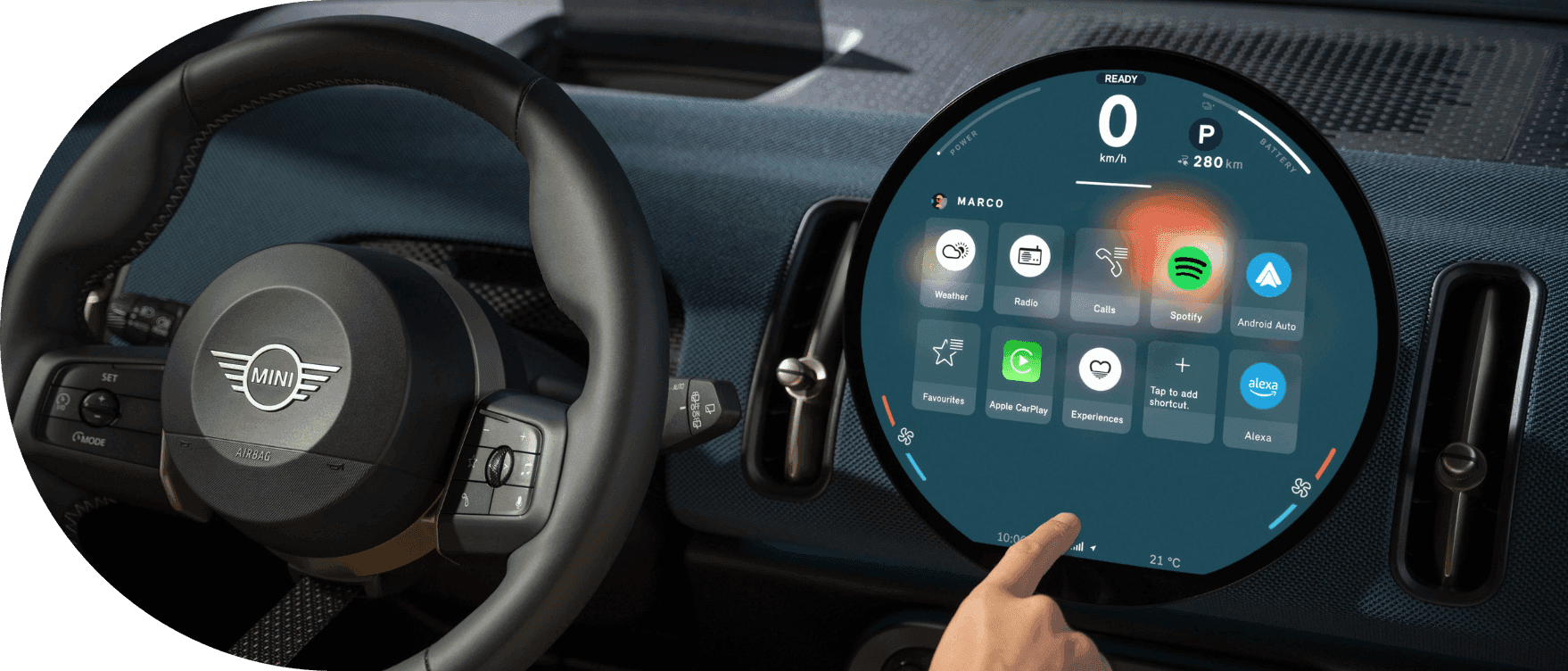
Giga UI began as an investigation into how conversational systems could enhance in-car navigation experiences. Drawing inspiration from MINI’s playful and human-centered design philosophy, our team explored how personality and clarity in voice interactions can transform routine driving moments into connected, characterful exchanges between driver and machine.
As vehicles become increasingly digital, the way drivers communicate with their cars is shifting from touch to voice. Yet, voice interfaces remain largely invisible and often misunderstood, users interact through sound, tone, and timing rather than sight. This creates both an opportunity and a challenge: how can we design a voice system that feels intuitive, responsive, and emotionally engaging, especially in a space where safety and attention are critical?
Giga UI began as an investigation into how conversational systems could enhance in-car navigation experiences. Drawing inspiration from MINI’s playful and human-centered design philosophy, our team explored how personality and clarity in voice interactions can transform routine driving moments into connected, characterful exchanges between driver and machine.
/
The Approach
(02)
/
The Approach
(02)
/
The Approach
(02)
Giving voice technology a sense of personality
Giving voice technology a sense of personality
This research examines how voice interfaces can create more human and characterful navigation experiences within existing systems like Google Maps. By prototyping conversational scenarios and conducting targeted user trials, we analyzed how drivers respond to tone, pacing, and feedback in voice-based interactions. The findings informed design principles for crafting intuitive, emotionally resonant VUIs that feel less like commands and more like dialogue, echoing MINI’s vision of technology with personality, empathy, and a sense of play behind the wheel.
This research examines how voice interfaces can create more human and characterful navigation experiences within existing systems like Google Maps. By prototyping conversational scenarios and conducting targeted user trials, we analyzed how drivers respond to tone, pacing, and feedback in voice-based interactions. The findings informed design principles for crafting intuitive, emotionally resonant VUIs that feel less like commands and more like dialogue, echoing MINI’s vision of technology with personality, empathy, and a sense of play behind the wheel.
/
The Process
(03)
/
The Process
(03)
/
The Process
(03)
A systematic exploration of how drivers perceive and interact with voice systems
A systematic exploration of how drivers perceive and interact with voice systems
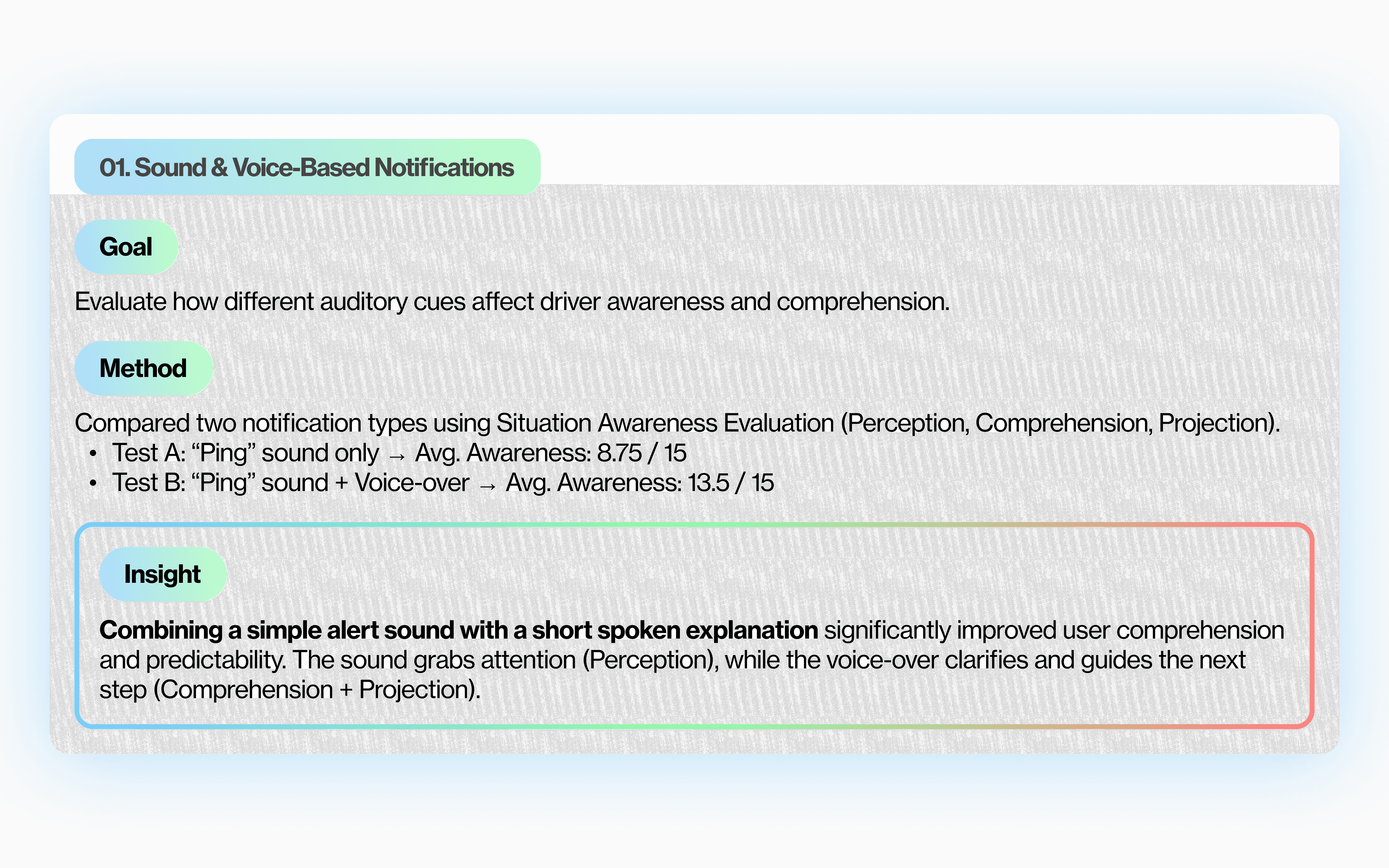
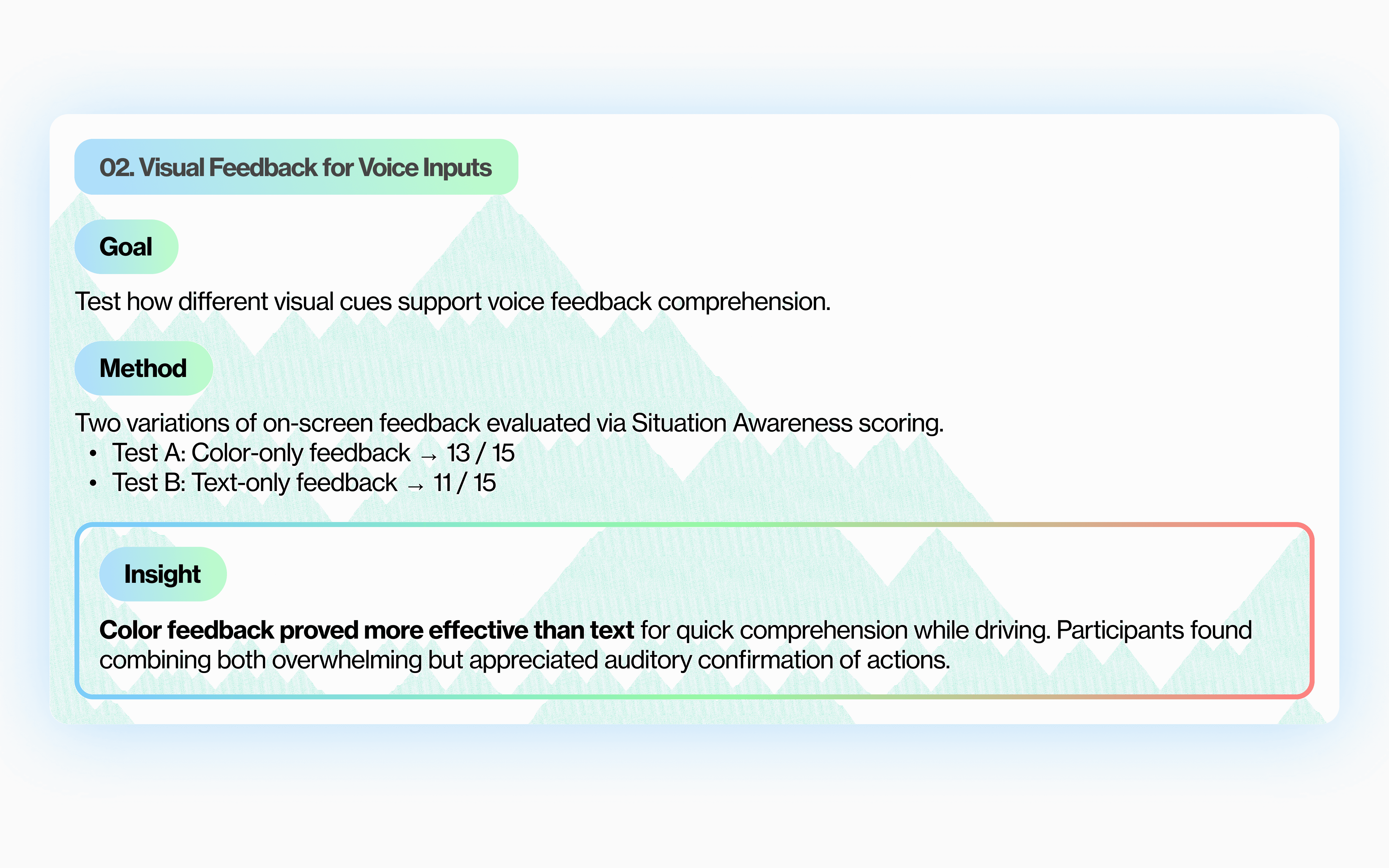
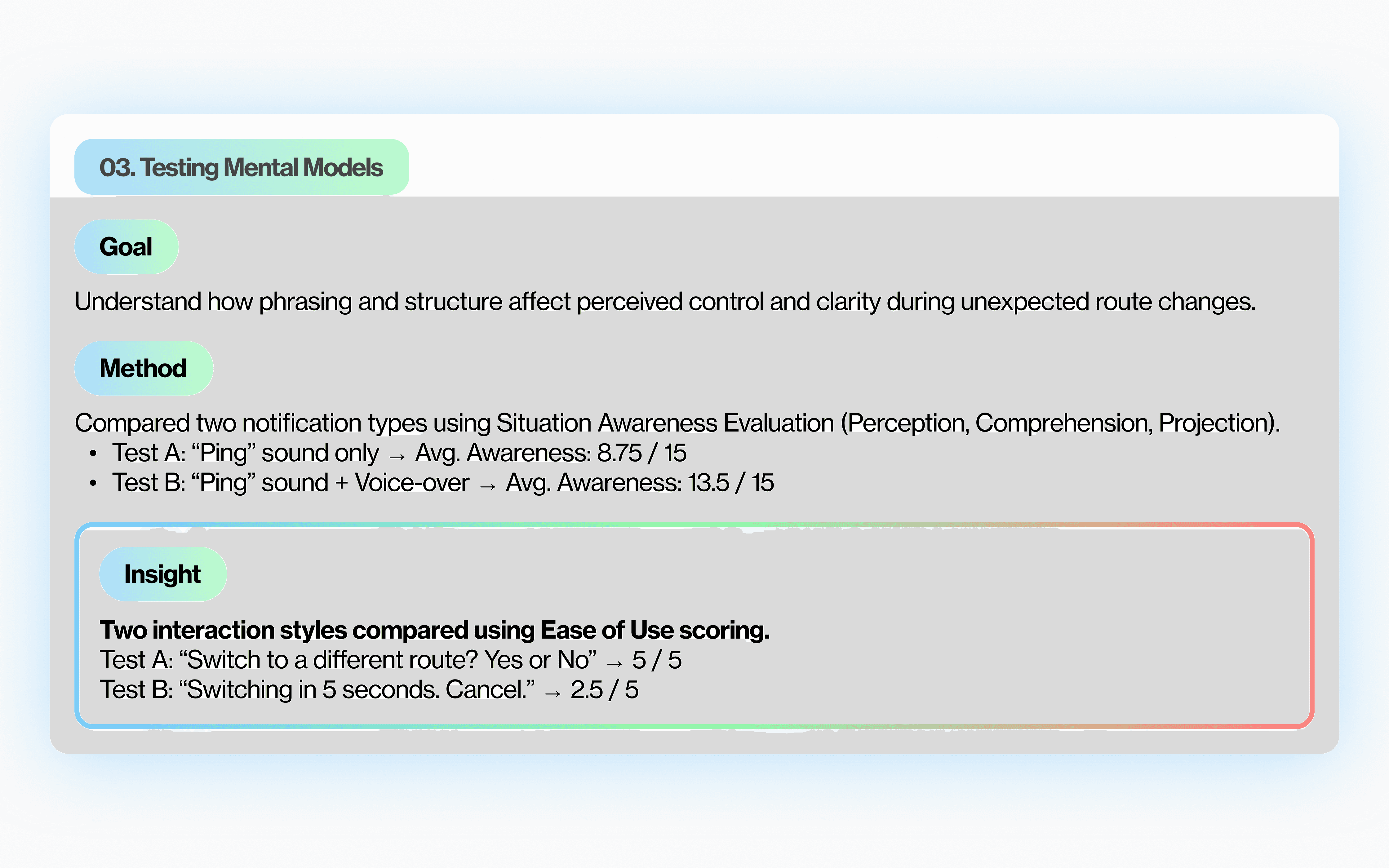
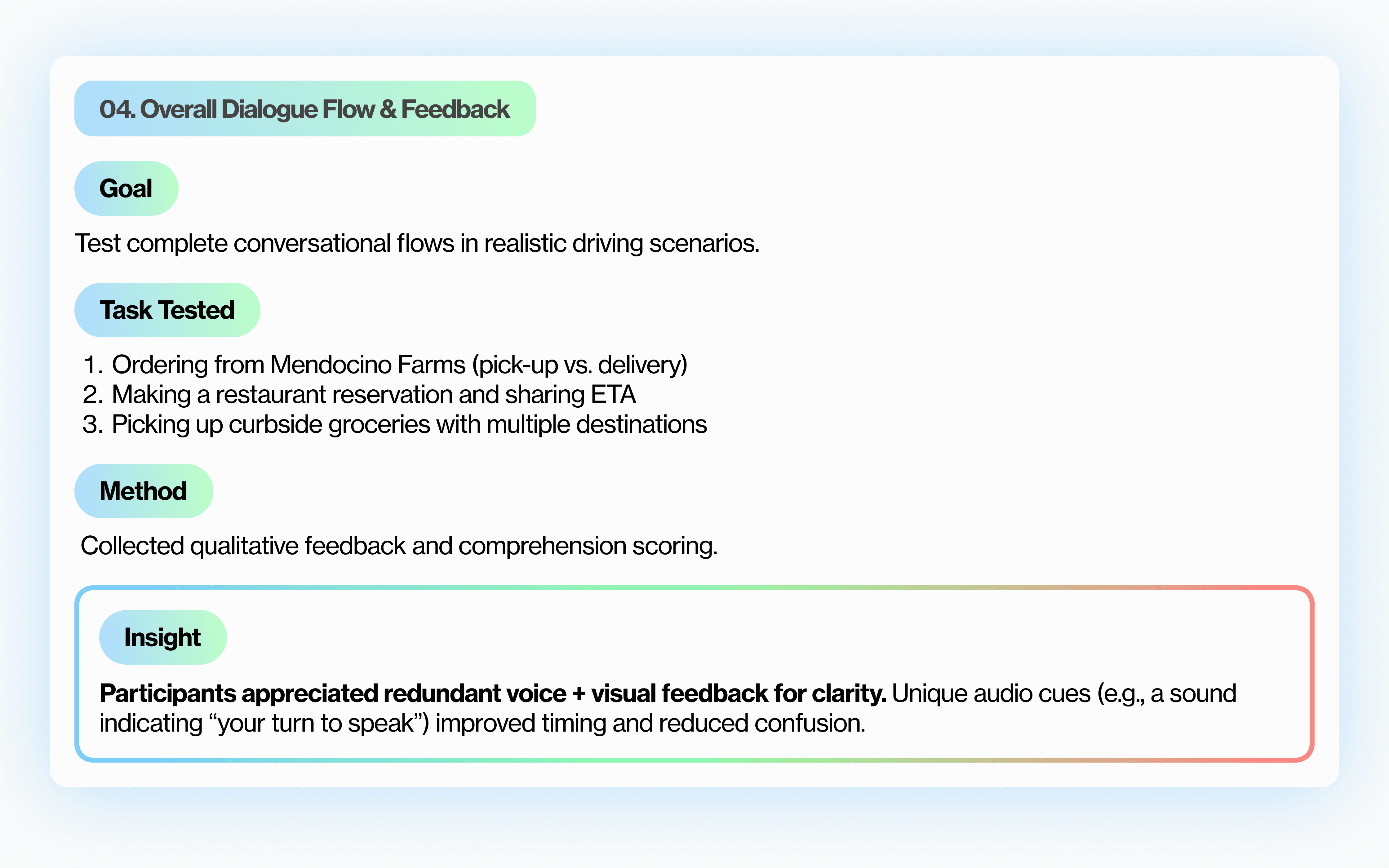
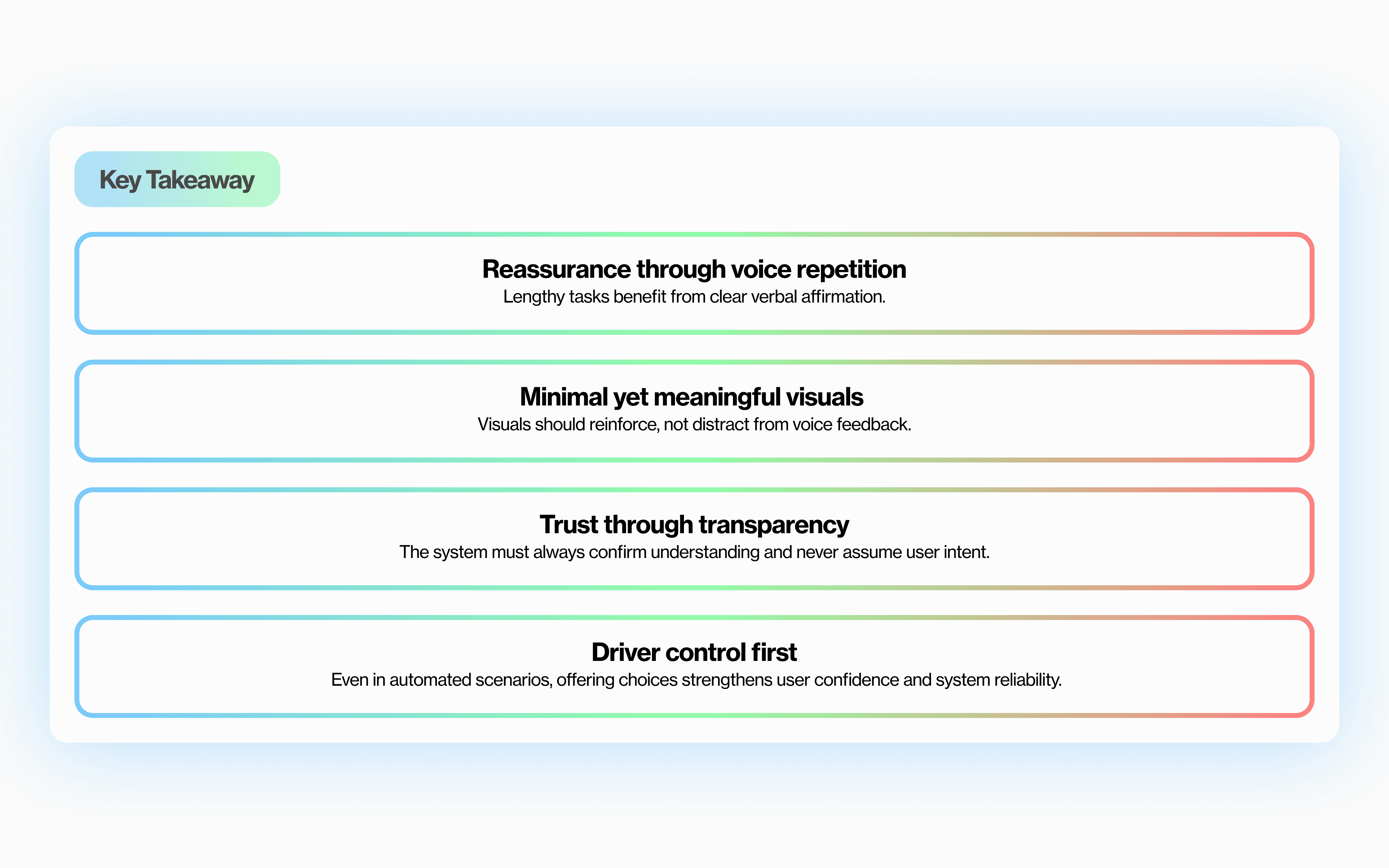
Our research and prototyping process was divided into four key experiments, each testing a specific aspect of voice user interface design within an in-car context. All tests were performed using a live voice-interactive prototype built in Proto.io, which responded directly to spoken input.
Our research and prototyping process was divided into four key experiments, each testing a specific aspect of voice user interface design within an in-car context. All tests were performed using a live voice-interactive prototype built in Proto.io, which responded directly to spoken input.
/
VUI Persona
(04)
/
VUI Persona
(04)
/
VUI Persona
(04)
A calm companion for conversational driving
A calm companion for conversational driving
Meet Giga, the voice persona designed for our in-car navigation assistant. Giga embodies reliability and calm, qualities essential for both drivers and passengers in high-attention environments.
His tone is warm yet composed, balancing friendliness with professionalism. Emotionally, Giga remains steady and neutral, offering reassurance rather than excitement during moments of stress or uncertainty on the road.
Visually, Giga’s identity is expressed through a set of dynamic facial states: a primary “default” face representing neutral presence, and four additional expressions that subtly shift in response to driving context and conversational cues. These visual variations reinforce his voice personality through gentle, human-like feedback.
Meet Giga, the voice persona designed for our in-car navigation assistant. Giga embodies reliability and calm, qualities essential for both drivers and passengers in high-attention environments.
His tone is warm yet composed, balancing friendliness with professionalism. Emotionally, Giga remains steady and neutral, offering reassurance rather than excitement during moments of stress or uncertainty on the road.
Visually, Giga’s identity is expressed through a set of dynamic facial states: a primary “default” face representing neutral presence, and four additional expressions that subtly shift in response to driving context and conversational cues. These visual variations reinforce his voice personality through gentle, human-like feedback.
/
VUI Dialogue Flow
(05)
/
VUI Dialogue Flow
(05)
/
VUI Dialogue Flow
(05)
Crafting natural exchanges between driver and interface
Crafting natural exchanges between driver and interface
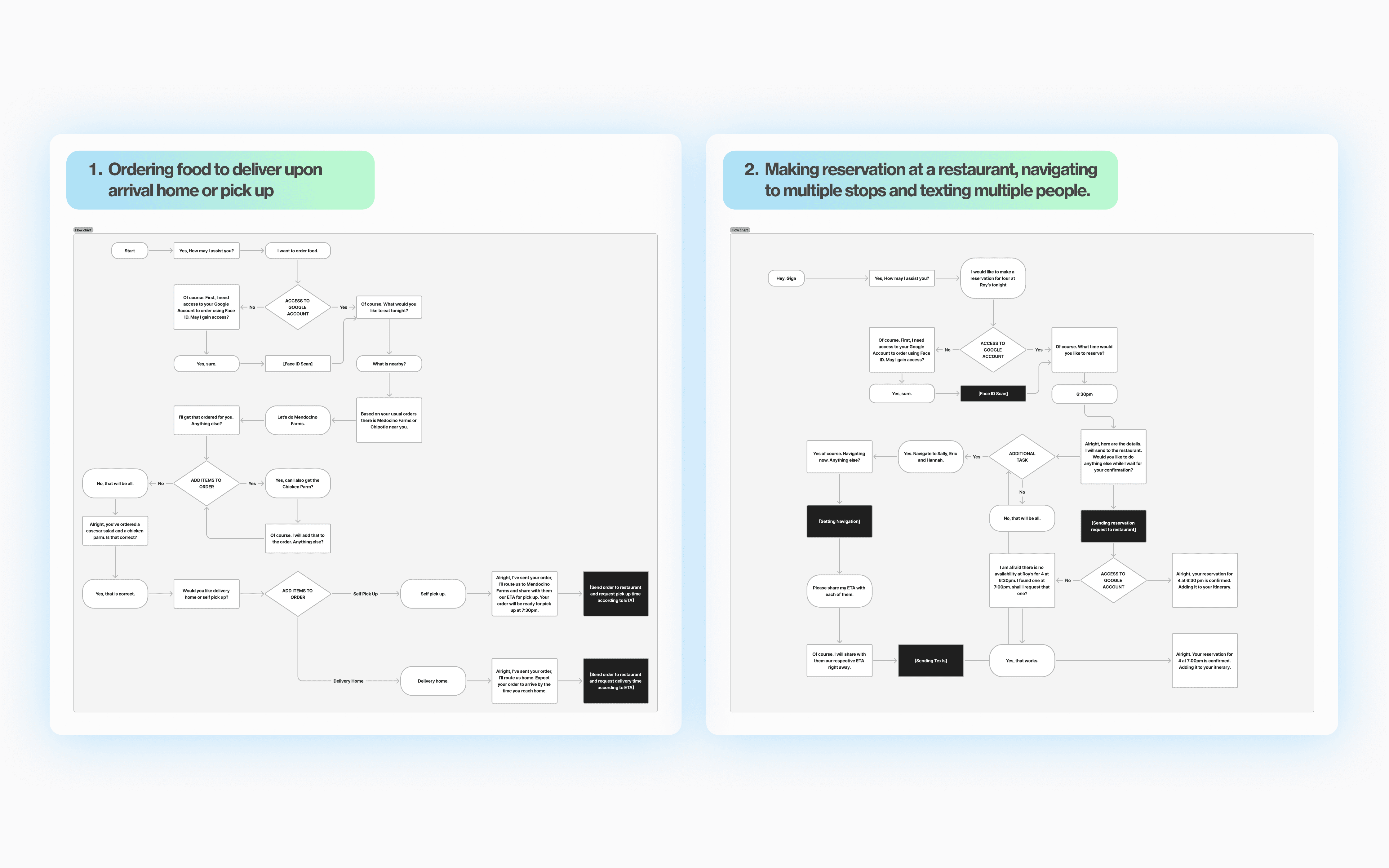
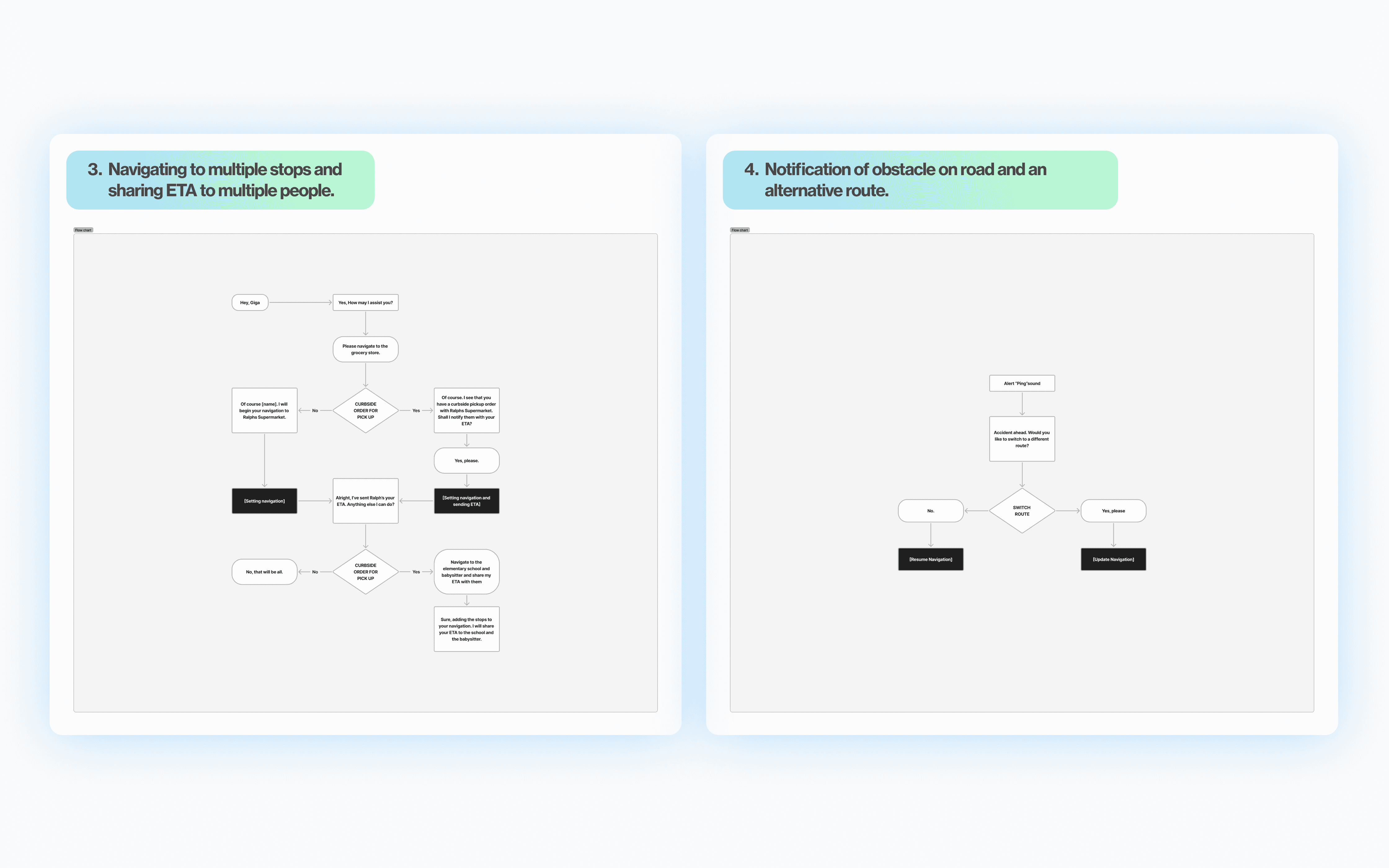
To evaluate how a voice assistant could communicate naturally during navigation, we mapped complete dialogue flows covering real driving scenarios, ordering food, making reservations, and handling multi-stop routes. Each flow was designed to balance clarity, timing, and tone, ensuring that the voice felt helpful yet unobtrusive.
We used information architecture mapping to define system states, possible user intents, and fallback responses, then translated these flows into a working Proto.io prototype for user testing.
To evaluate how a voice assistant could communicate naturally during navigation, we mapped complete dialogue flows covering real driving scenarios, ordering food, making reservations, and handling multi-stop routes. Each flow was designed to balance clarity, timing, and tone, ensuring that the voice felt helpful yet unobtrusive.
We used information architecture mapping to define system states, possible user intents, and fallback responses, then translated these flows into a working Proto.io prototype for user testing.
/
Visual Interaction
(06)
/
Visual Interaction
(06)
/
Visual Interaction
(06)
Crafting natural exchanges between driver and interface
Crafting natural exchanges between driver and interface
To evaluate how a voice assistant could communicate naturally during navigation, we mapped complete dialogue flows covering real driving scenarios, ordering food, making reservations, and handling multi-stop routes. Each flow was designed to balance clarity, timing, and tone, ensuring that the voice felt helpful yet unobtrusive.
We used information architecture mapping to define system states, possible user intents, and fallback responses, then translated these flows into a working Proto.io prototype for user testing.
To evaluate how a voice assistant could communicate naturally during navigation, we mapped complete dialogue flows covering real driving scenarios, ordering food, making reservations, and handling multi-stop routes. Each flow was designed to balance clarity, timing, and tone, ensuring that the voice felt helpful yet unobtrusive.
We used information architecture mapping to define system states, possible user intents, and fallback responses, then translated these flows into a working Proto.io prototype for user testing.
/
Reflection
(07)
/
Reflection
(07)
/
Reflection
(07)
What I Learned
What I Learned
Through this project, I deepened my understanding of how Voice User Interfaces can shape user perception and confidence, particularly in high-focus environments like driving.
Building and testing multiple dialogue flows highlighted the value of information architecture as the backbone of clarity in invisible systems. Mapping each conversation helped me anticipate user intent, locate friction points, and define when voice feedback should be supported by visual cues.
At the same time, I learned how visual design plays an equally important supporting role. Subtle animations, color shifts, and feedback states on screen reinforce the rhythm and tone of spoken interaction without competing for attention. Balancing these visual and auditory layers became key to designing an experience that feels intuitive, calm, and emotionally grounded.
Overall, this project strengthened my belief that effective VUI design lives at the intersection of structure and sensibility, where information architecture guides logic, and visual design communicates empathy.
Through this project, I deepened my understanding of how Voice User Interfaces can shape user perception and confidence, particularly in high-focus environments like driving.
Building and testing multiple dialogue flows highlighted the value of information architecture as the backbone of clarity in invisible systems. Mapping each conversation helped me anticipate user intent, locate friction points, and define when voice feedback should be supported by visual cues.
At the same time, I learned how visual design plays an equally important supporting role. Subtle animations, color shifts, and feedback states on screen reinforce the rhythm and tone of spoken interaction without competing for attention. Balancing these visual and auditory layers became key to designing an experience that feels intuitive, calm, and emotionally grounded.
Overall, this project strengthened my belief that effective VUI design lives at the intersection of structure and sensibility, where information architecture guides logic, and visual design communicates empathy.
Latest Projects.
(08)
Latest Projects.
(08)
Latest Projects.
(08)
A curated selection of projects that tell stories through the balance of digital and physical design.