Sphere
Drop
Sphere
Drop
Sphere
Drop
What if capturing a photo could feel like collecting a shared memory, not just taking a picture? Sphere Drop is a gesture-driven, interactive installation that transforms photos into floating memory spheres—inviting people to collect, play with, and share moments together.
What if capturing a photo could feel like collecting a shared memory, not just taking a picture? Sphere Drop is a gesture-driven, interactive installation that transforms photos into floating memory spheres—inviting people to collect, play with, and share moments together.
Gesture Interaction
View all projects
Interactive Installation
View all projects
Digital–Physical Experience
View all projects
Shared Memory
View all projects
Embodied Interaction
View all projects
Creative Coding
View all projects
Scope
Installation Prototype
Role
Interaction Designer (Solo)
Duration
4 weeks
Year
2025
/
Concept
(01)
Photography is usually a solitary click. I wanted to turn it into a shared, physical ritual.
Sphere Drop is an installation where visitors capture memories not by pressing a button, but by "catching" moments from the air.
Photography is usually a solitary click. I wanted to turn it into a shared, physical ritual.
Sphere Drop is an installation where visitors capture memories not by pressing a button, but by "catching" moments from the air.
/
Process
(02)
How I built it
How I built it
I built a custom gesture engine that translates 3D hand data into WebGL physics.
Sensing: Ultraleap hand tracking (capturing position + orientation).
Visuals: React + WebGL (Custom shaders for the "glass" look).
Networking: WebSockets for low-latency communication between the sensor and the display.
Generative Coding: I used Google AI Studio and Claude to rapid-prototype the complex vector math required for the gesture logic, allowing me to iterate on the "physics" of the spheres faster than traditional coding permits.
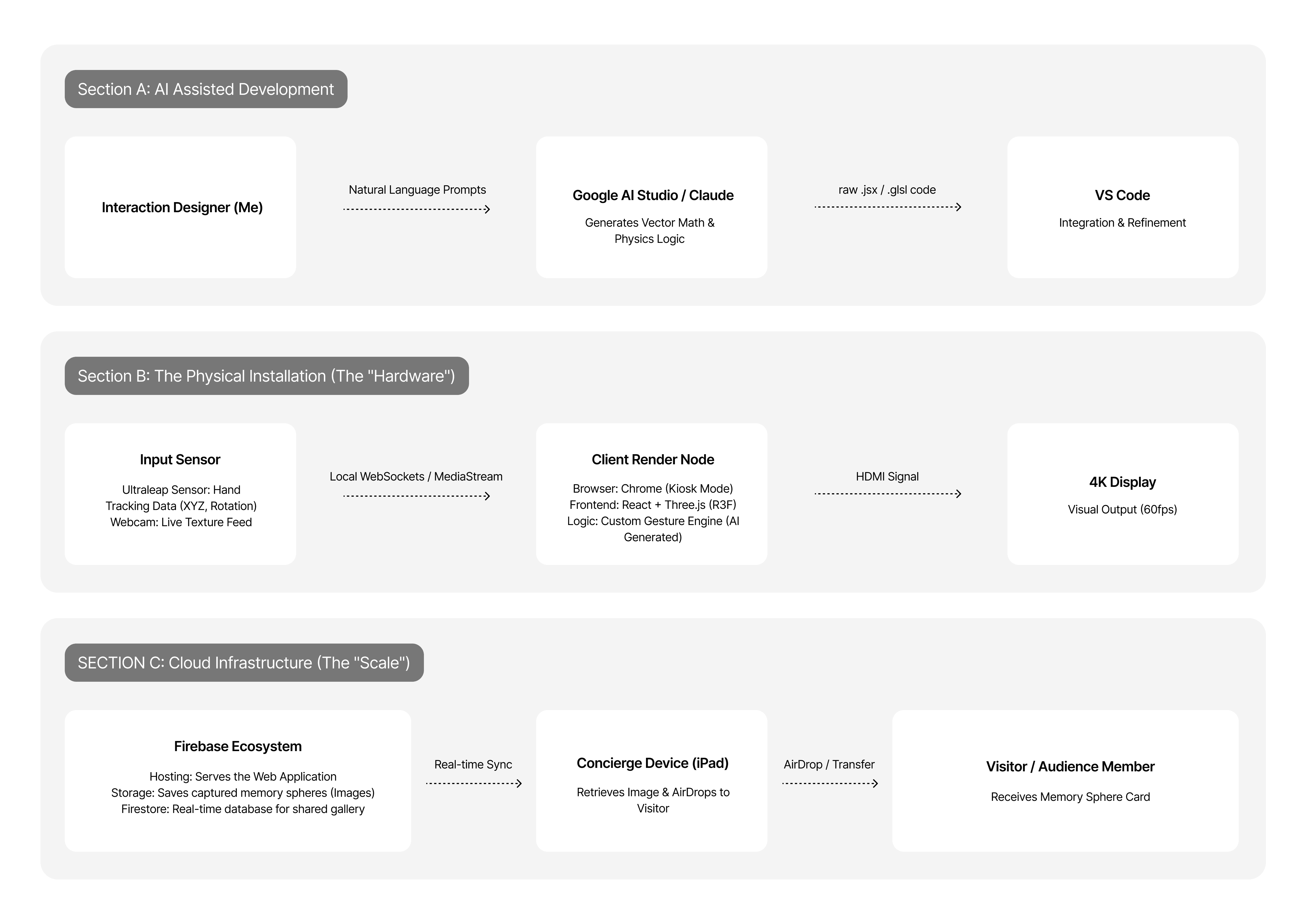
System Architecture & Data Flow:
Sphere Drop operates as a hybrid cloud/local application. The visual core is a React Three Fiber (R3F) application hosted on Firebase, running in Kiosk mode on the local client.
To bridge the gap between concept and code, I utilized Google AI Studio as a technical partner, generating the complex vector mathematics required for the gesture physics engine. Real-time hand data is streamed from the Ultraleap sensor via local WebSockets, ensuring low-latency interaction, while captured memories are instantly uploaded to Firebase Storage for mobile sharing.
I built a custom gesture engine that translates 3D hand data into WebGL physics.
Sensing: Ultraleap hand tracking (capturing position + orientation).
Visuals: React + WebGL (Custom shaders for the "glass" look).
Networking: WebSockets for low-latency communication between the sensor and the display.
Generative Coding: I used Google AI Studio and Claude to rapid-prototype the complex vector math required for the gesture logic, allowing me to iterate on the "physics" of the spheres faster than traditional coding permits.
System Architecture & Data Flow:
Sphere Drop operates as a hybrid cloud/local application. The visual core is a React Three Fiber (R3F) application hosted on Firebase, running in Kiosk mode on the local client.
To bridge the gap between concept and code, I utilized Google AI Studio as a technical partner, generating the complex vector mathematics required for the gesture physics engine. Real-time hand data is streamed from the Ultraleap sensor via local WebSockets, ensuring low-latency interaction, while captured memories are instantly uploaded to Firebase Storage for mobile sharing.
/
Design Direction
(03)
Memory as a Physical Object
Memory as a Physical Object
Memories are not flat, static photographs; they are dimensional entities that occupy space in our minds. For Sphere Drop, I translated on-screen pixels into 'Memory Spheres' with physical weight and texture, granting an analog, tactile quality to a purely digital interaction.
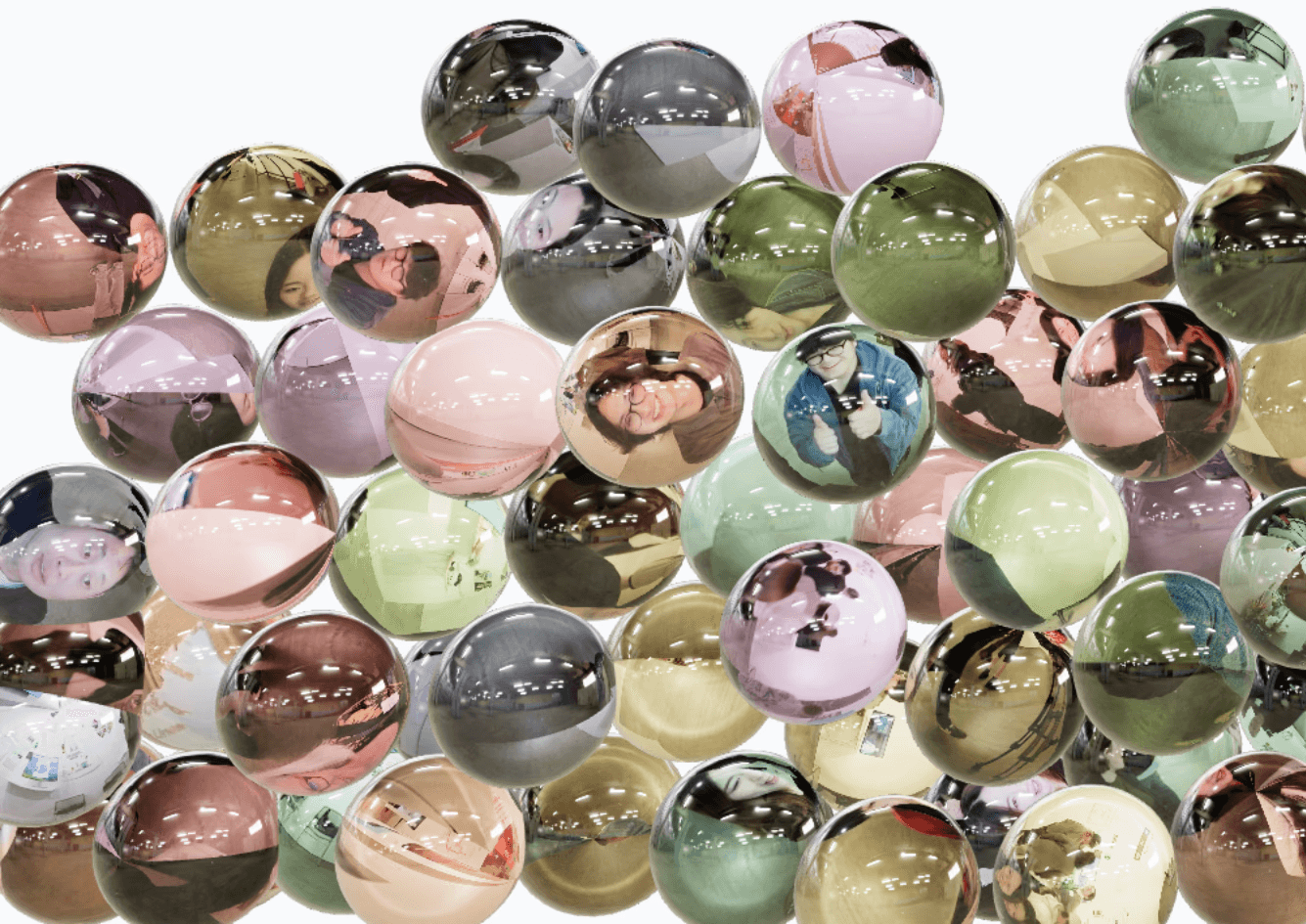
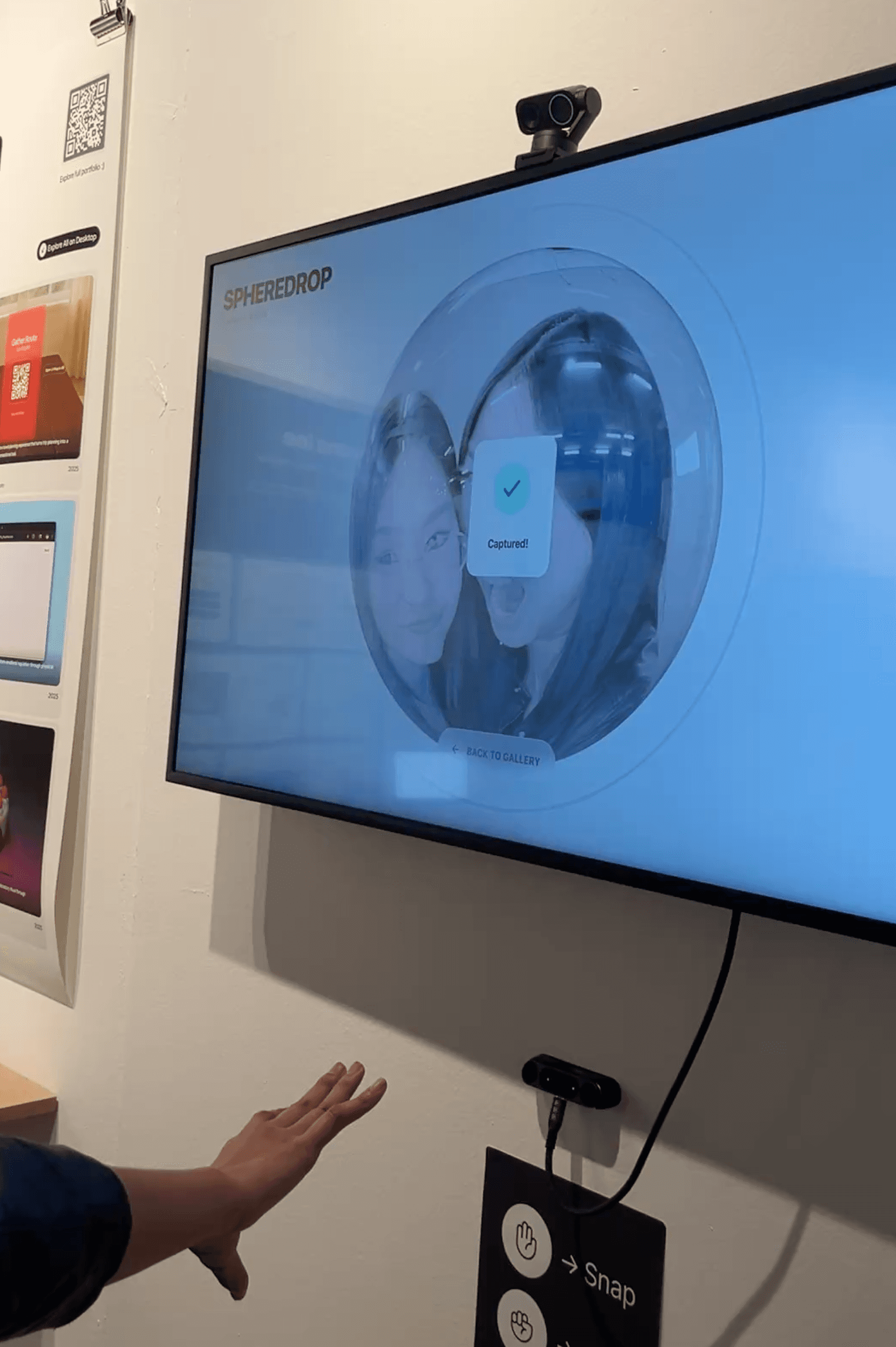
Refraction & Glassmorphism: I designed custom WebGL shaders that sit on the boundary between transparent glass and fragile soap bubbles. The way faces and physical spaces refract within these spheres creates a dreamy, surreal visual experience—much like peering into an encapsulated memory.
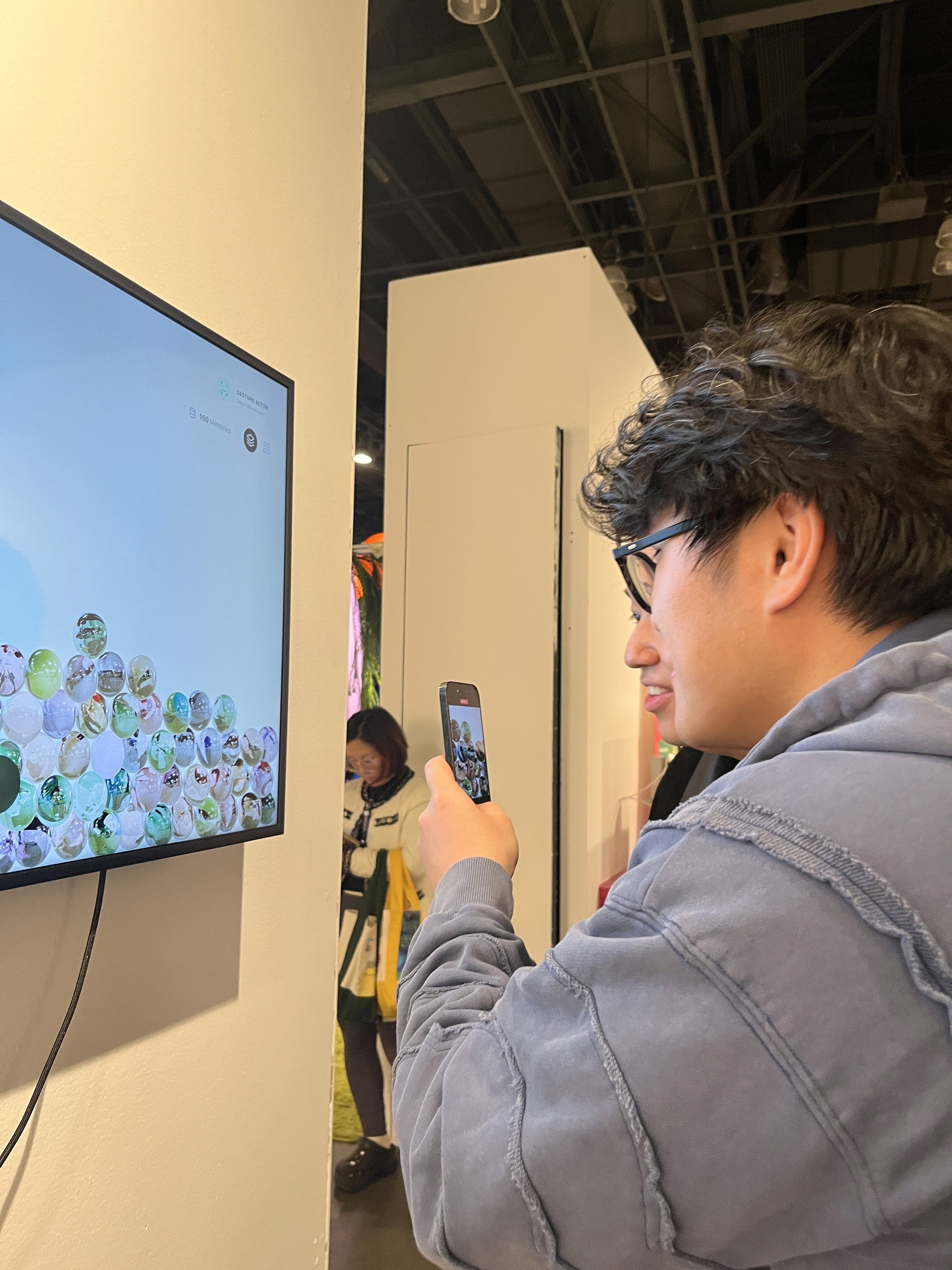
Organic Clustering (The Archive View): As hundreds of spheres drop and accumulate, their unpredictable layout becomes a piece of generative 'cluster art.' Breaking away from rigid digital grids, the overlapping, reflecting spheres create a visual feast of color and light. This serves as a visual metaphor for a 'collective archive'—a shared presence built by individual, playful participation.
Zero-UI Approach: To ensure users remain fully immersed in the beauty and physics of the 3D objects, I kept the system interface (
GESTURE ACTIVE,150 Memories) extremely minimal. Traditional text-based system feedback was intentionally replaced with environmental cues—such as shifts in lighting and the physical bouncing of the spheres—to maximize intuitive, gesture-driven play.
Structured Retrieval (The Grid Gallery): While the physics-driven Archive View leans into chaotic, organic play, I recognized the necessity of functional usability. To balance poetic interaction with practical UX, I designed a secondary 'Grid Gallery' view. This mode organizes the captured memories into a clean, structured layout, allowing users to effortlessly locate, select, and retrieve their specific photos after the moment of joyful capture—eliminating the friction of searching through a dynamic pile.
Memories are not flat, static photographs; they are dimensional entities that occupy space in our minds. For Sphere Drop, I translated on-screen pixels into 'Memory Spheres' with physical weight and texture, granting an analog, tactile quality to a purely digital interaction.
Refraction & Glassmorphism: I designed custom WebGL shaders that sit on the boundary between transparent glass and fragile soap bubbles. The way faces and physical spaces refract within these spheres creates a dreamy, surreal visual experience—much like peering into an encapsulated memory.
Organic Clustering (The Archive View): As hundreds of spheres drop and accumulate, their unpredictable layout becomes a piece of generative 'cluster art.' Breaking away from rigid digital grids, the overlapping, reflecting spheres create a visual feast of color and light. This serves as a visual metaphor for a 'collective archive'—a shared presence built by individual, playful participation.
Zero-UI Approach: To ensure users remain fully immersed in the beauty and physics of the 3D objects, I kept the system interface (
GESTURE ACTIVE,150 Memories) extremely minimal. Traditional text-based system feedback was intentionally replaced with environmental cues—such as shifts in lighting and the physical bouncing of the spheres—to maximize intuitive, gesture-driven play.
Structured Retrieval (The Grid Gallery): While the physics-driven Archive View leans into chaotic, organic play, I recognized the necessity of functional usability. To balance poetic interaction with practical UX, I designed a secondary 'Grid Gallery' view. This mode organizes the captured memories into a clean, structured layout, allowing users to effortlessly locate, select, and retrieve their specific photos after the moment of joyful capture—eliminating the friction of searching through a dynamic pile.
/
Experience
(04)
What People Did
What People Did
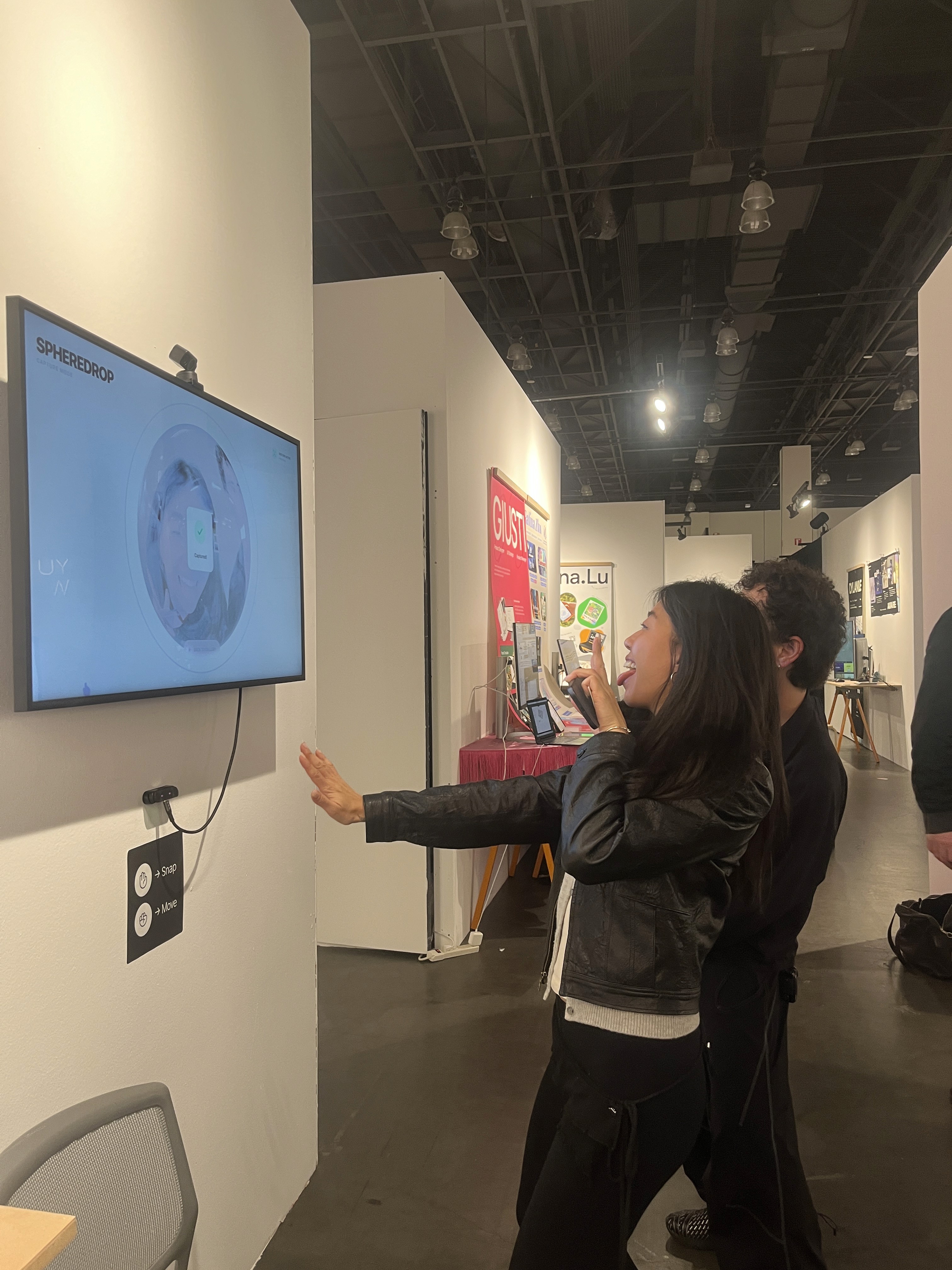
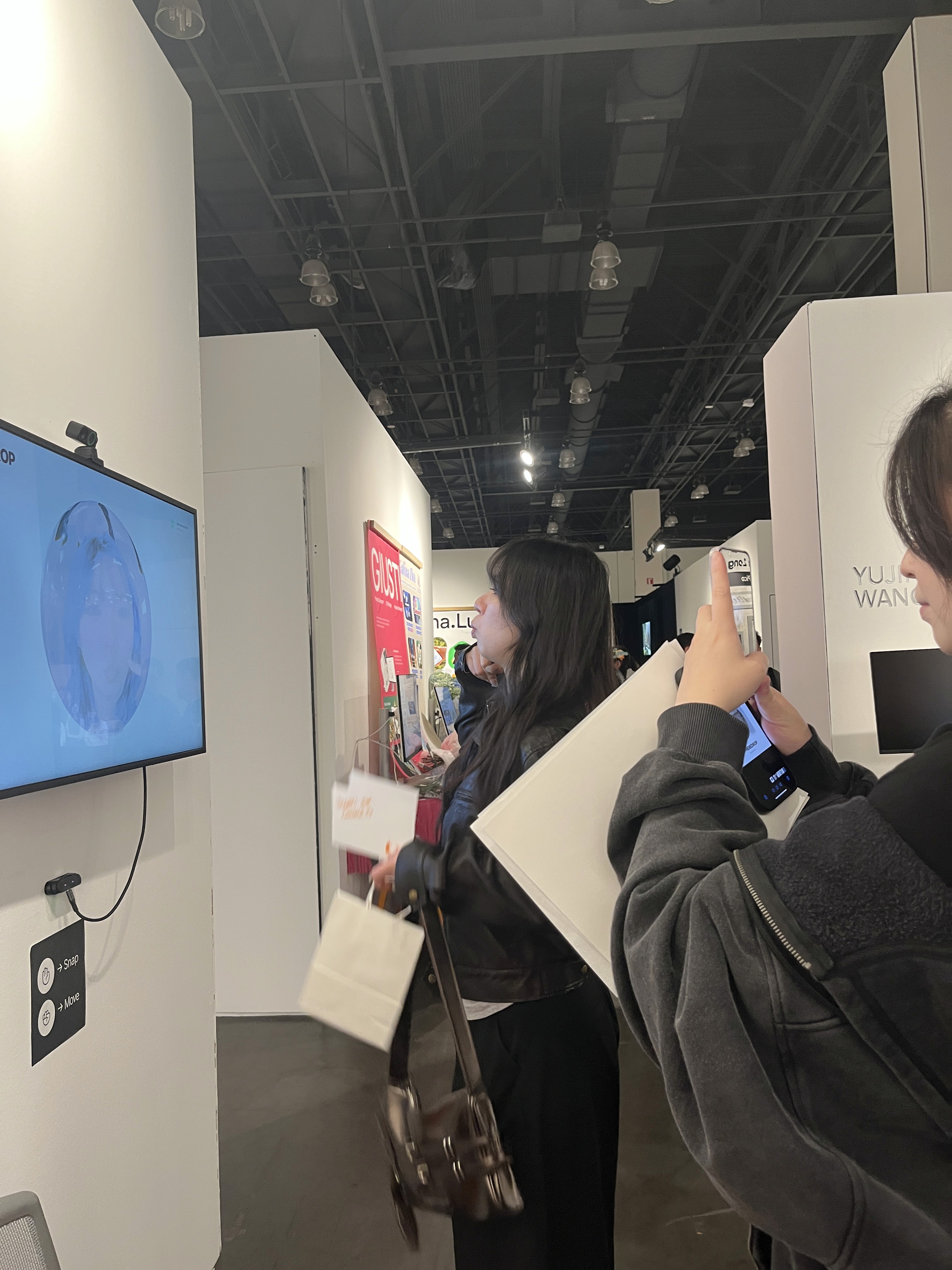
During the exhibition, visitors quickly understood the interaction through movement alone. Groups began to gather, gesture together, and play with the growing collection of memory spheres on screen.
As more photos were captured, spheres began to overlap and accumulate—visually reflecting shared participation and collective presence.
The Interaction
Detect: The system recognizes an open palm.
Capture: Closing the hand into a fist "crystallizes" the live video feed into a floating 3D sphere.
Play: Users can physically bat, push, and collide with the saved memory spheres, turning the screen into a chaotic, joyful playground.
During the exhibition, visitors quickly understood the interaction through movement alone. Groups began to gather, gesture together, and play with the growing collection of memory spheres on screen.
As more photos were captured, spheres began to overlap and accumulate—visually reflecting shared participation and collective presence.
The Interaction
Detect: The system recognizes an open palm.
Capture: Closing the hand into a fist "crystallizes" the live video feed into a floating 3D sphere.
Play: Users can physically bat, push, and collide with the saved memory spheres, turning the screen into a chaotic, joyful playground.
/
Observation & Outcome
(05)
What Actually Happened
What Actually Happened
Over 300 photos were captured during the exhibition
Many spheres overlapped, indicating repeated and group interactions
Some teams generated a dense cluster of memory spheres, suggesting prolonged engagement
Visitors often stayed longer than expected, laughing, experimenting, and inviting others to join
Visitors intuitively understood the physics without onboarding. Strangers began collaborating to "catch" each other's photos.
Proved that LLM-assisted coding can enable solo designers to build complex, high-performance interactive systems in short timeframes (4 weeks).
Over 300 photos were captured during the exhibition
Many spheres overlapped, indicating repeated and group interactions
Some teams generated a dense cluster of memory spheres, suggesting prolonged engagement
Visitors often stayed longer than expected, laughing, experimenting, and inviting others to join
Visitors intuitively understood the physics without onboarding. Strangers began collaborating to "catch" each other's photos.
Proved that LLM-assisted coding can enable solo designers to build complex, high-performance interactive systems in short timeframes (4 weeks).
/
Reflection
(06)
Why It Matters
Why It Matters
Joy is a valid metric. In a world of utility-driven apps, Sphere Drop validates the importance of "Playful Computing." It proves that when we strip away explicit UIs and rely on natural instinct (body language), technology stops being a tool for isolation and becomes a catalyst for social connection and collective memory.
Joy is a valid metric. In a world of utility-driven apps, Sphere Drop validates the importance of "Playful Computing." It proves that when we strip away explicit UIs and rely on natural instinct (body language), technology stops being a tool for isolation and becomes a catalyst for social connection and collective memory.
Latest Projects.
(07)
A curated selection of projects that tell stories through the balance of digital and physical design.