Gather
Route.
Gather Route.
Gather
Route.
What if planning a trip could feel like the journey itself? An AR-enabled travel planning experience designed for collaborative, multi-generational decision-making.
What if planning a trip could feel like the journey itself? An AR-enabled travel planning experience designed for collaborative, multi-generational decision-making.
AR Interaction Design
View all projects
Spatial UX
View all projects
User Research
View all projects
Prototyping
View all projects
System Thinking
View all projects
Collaborative Design
View all projects
Future Interface Design
View all projects
Scope
AR Experience Design
Role
UX/UI & Interaction Designer (Team)
Duration
14 weeks
Year
2025
/
Problem
(01)
The Challenge of Group Travel Planning
The Challenge of Group Travel Planning
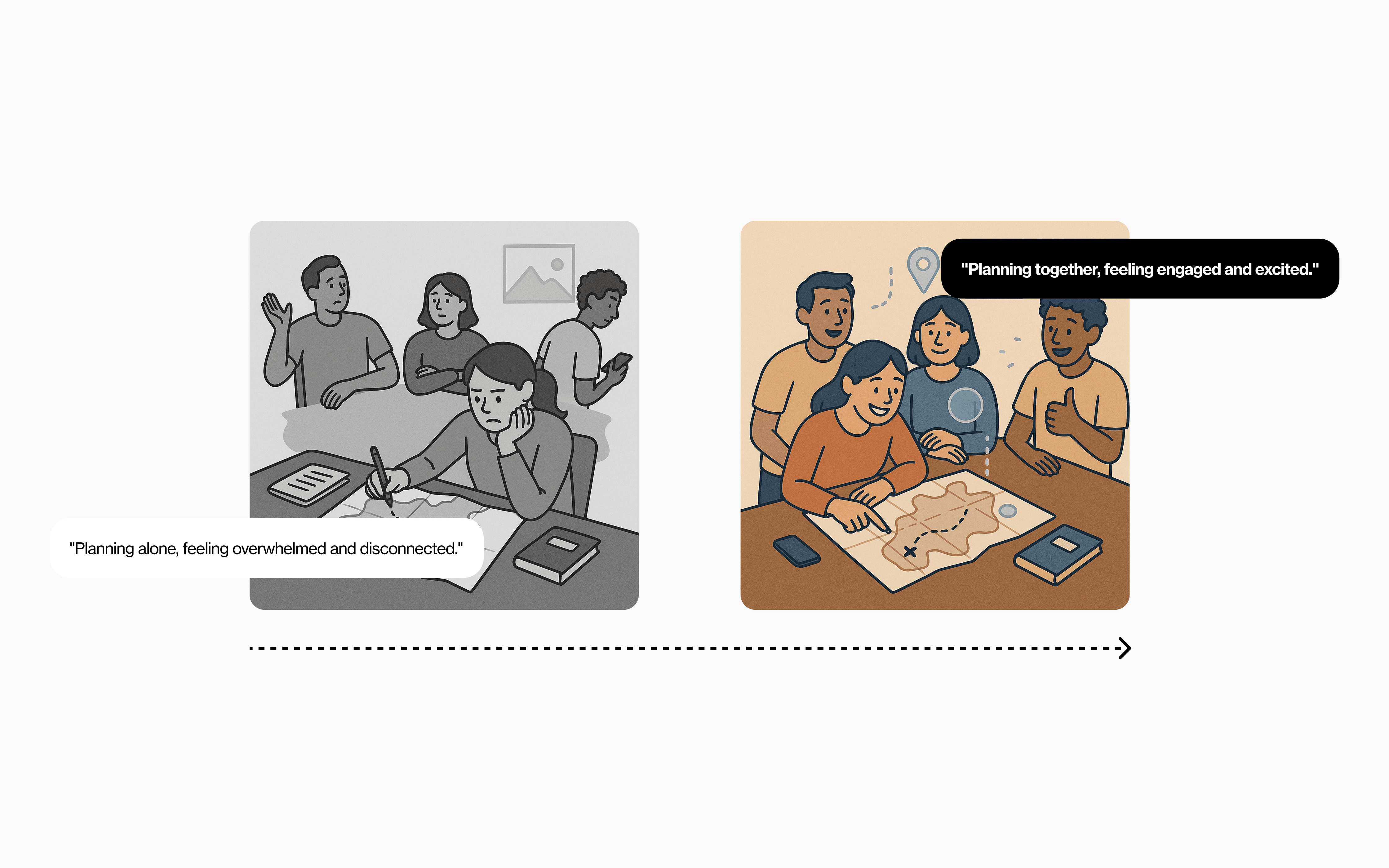
Travel planning usually isolates groups into individual phone screens, killing the excitement of the journey before it begins. I wanted to explore how Augmented Reality could bring people back to a shared physical table, bridging the gap between digital data and human connection.
Travel planning usually isolates groups into individual phone screens, killing the excitement of the journey before it begins. I wanted to explore how Augmented Reality could bring people back to a shared physical table, bridging the gap between digital data and human connection.
/
The Goal
(02)
To turn travel planning into a shared, interactive experience that sparks anticipation and connection.
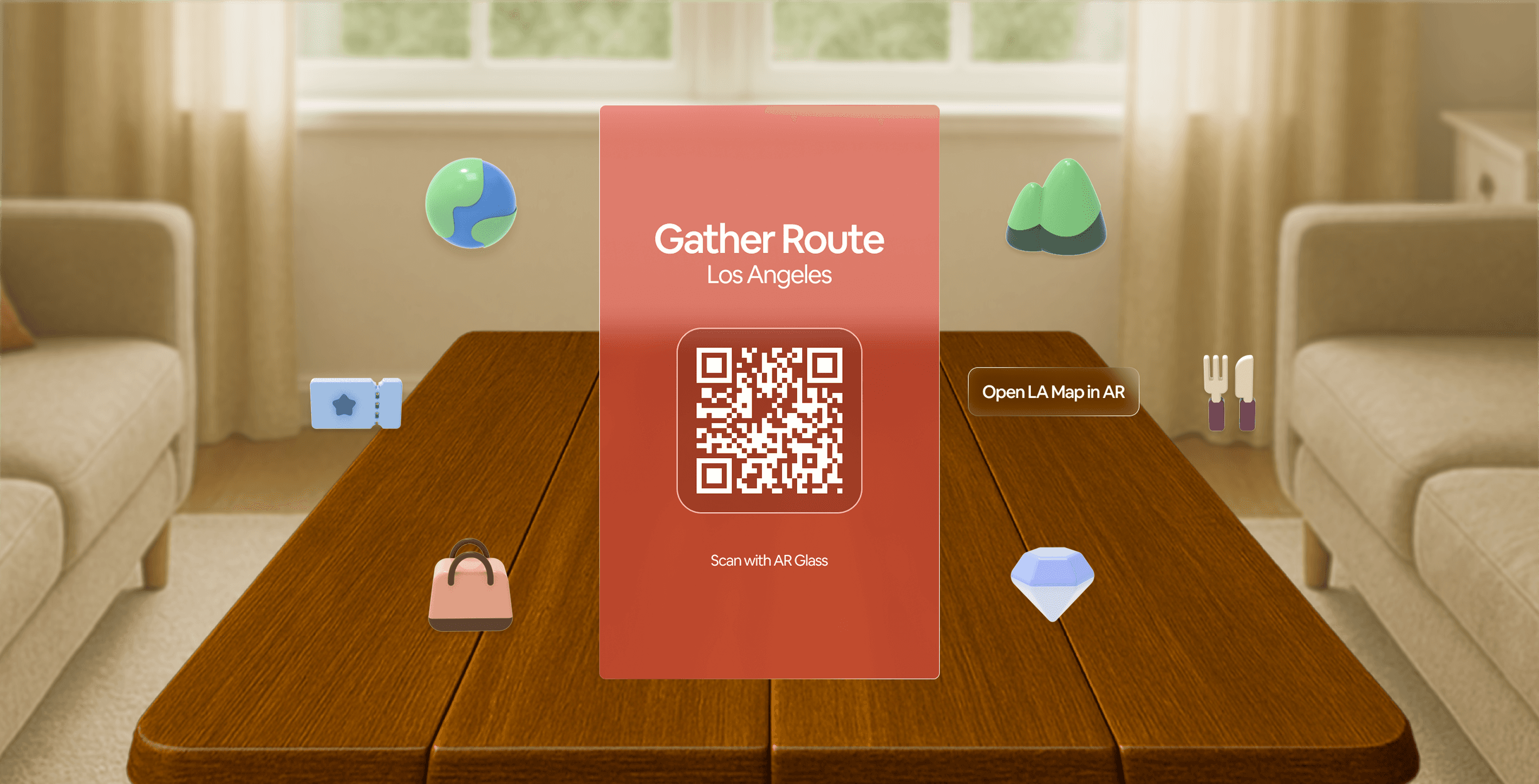
Gather Route is a spatial interface that uses a physical paper map as a digital anchor. Instead of staring at separate devices, users gather around a map. By viewing the map through a lens (AR Glasses), dynamic data—routes and landmarks—is physically "pinned" to the paper. It transforms a static object into a live, collaborative dashboard.
Gather Route is a spatial interface that uses a physical paper map as a digital anchor. Instead of staring at separate devices, users gather around a map. By viewing the map through a lens (AR Glasses), dynamic data—routes and landmarks—is physically "pinned" to the paper. It transforms a static object into a live, collaborative dashboard.
/
Design Rationale
(03)
Why AR for Group Planning
Why AR for Group Planning
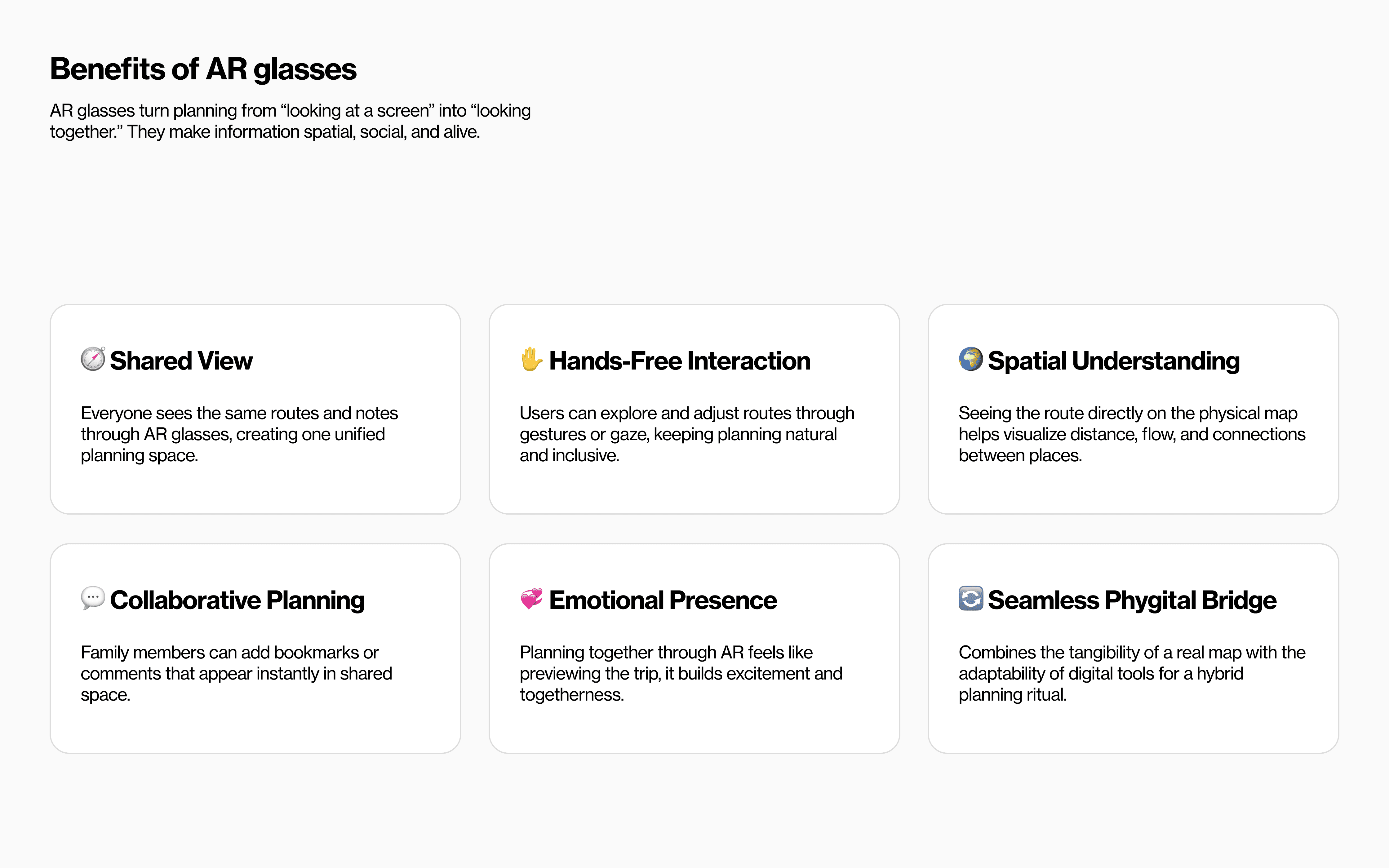
AR allows travel information to live directly on a shared physical map, preserving the clarity of 2D data while enabling spatial interaction. This approach supports collaboration, shared understanding, and inclusive planning—especially for multi-generational groups.
AR allows travel information to live directly on a shared physical map, preserving the clarity of 2D data while enabling spatial interaction. This approach supports collaboration, shared understanding, and inclusive planning—especially for multi-generational groups.
/
Design Direction
(04)
Calm Spatial Computing: Bridging the Physical and Digital
Calm Spatial Computing: Bridging the Physical and Digital
The design of Gather Route is rooted in the philosophy of "Calm Technology." Rather than overwhelming the user with a fully immersive VR world, I utilized AR to enhance a familiar physical object—the paper map. The goal was to create a "Shared Reality" where technology facilitates human eye contact and conversation rather than obstructing it.
Contextual Layering & Spatial Hierarchy: Travel data can be dense and overwhelming. I designed a clear spatial hierarchy where high-level geographical data (landmarks) sits closest to the physical map, while interactive personal data (bookmarks, filters) hovers in the mid-ground. This ensures that the physical table remains the "ground truth" of the interaction.
Shared Visual Anchors: In group planning, "visibility is alignment." I developed a system of shared spatial pins—color-coded by user—that allow every participant to see what others are looking at in real-time. This transforms invisible digital browsing into a visible, communal act, making decision-making inclusive for all generations.
The "Glass Map" Aesthetic: To maintain a sense of lightness, the UI employs a refined Glassmorphism language. The semi-transparent containers and soft shadows allow the physical texture of the paper map to bleed through, ensuring the digital interface feels like a natural extension of the room’s lighting and environment rather than a disconnected overlay.
Inclusive Gestural Grammar: Recognizing that travel planning often involves family members of various tech-literacy levels, I prioritized Natural Mapping. Gestures mimic real-world actions: "dropping" a pin or "scanning" a map. By removing the abstraction of traditional menus, the interface becomes an intuitive playground for collaboration.
The design of Gather Route is rooted in the philosophy of "Calm Technology." Rather than overwhelming the user with a fully immersive VR world, I utilized AR to enhance a familiar physical object—the paper map. The goal was to create a "Shared Reality" where technology facilitates human eye contact and conversation rather than obstructing it.
Contextual Layering & Spatial Hierarchy: Travel data can be dense and overwhelming. I designed a clear spatial hierarchy where high-level geographical data (landmarks) sits closest to the physical map, while interactive personal data (bookmarks, filters) hovers in the mid-ground. This ensures that the physical table remains the "ground truth" of the interaction.
Shared Visual Anchors: In group planning, "visibility is alignment." I developed a system of shared spatial pins—color-coded by user—that allow every participant to see what others are looking at in real-time. This transforms invisible digital browsing into a visible, communal act, making decision-making inclusive for all generations.
The "Glass Map" Aesthetic: To maintain a sense of lightness, the UI employs a refined Glassmorphism language. The semi-transparent containers and soft shadows allow the physical texture of the paper map to bleed through, ensuring the digital interface feels like a natural extension of the room’s lighting and environment rather than a disconnected overlay.
Inclusive Gestural Grammar: Recognizing that travel planning often involves family members of various tech-literacy levels, I prioritized Natural Mapping. Gestures mimic real-world actions: "dropping" a pin or "scanning" a map. By removing the abstraction of traditional menus, the interface becomes an intuitive playground for collaboration.
/
Interaction Flow
(05)
How It Works
How It Works
The system creates a "shared reality" where digital objects respect physical boundaries.
Anchor: The camera detects the high-contrast physical map, instantly locking the coordinate system.
Layer: Contextual data (Airbnb prices, ratings) hovers over specific geographies.
Collaborate: When one user "drops" a pin on their screen, it appears spatially for everyone else, turning decision-making into a visible, communal act.
The system creates a "shared reality" where digital objects respect physical boundaries.
Anchor: The camera detects the high-contrast physical map, instantly locking the coordinate system.
Layer: Contextual data (Airbnb prices, ratings) hovers over specific geographies.
Collaborate: When one user "drops" a pin on their screen, it appears spatially for everyone else, turning decision-making into a visible, communal act.
Explore Together
Explore Together
AR overlays reveal destinations, filters, and contextual travel data on a shared physical map
AR overlays reveal destinations, filters, and contextual travel data on a shared physical map
Bookmark & Compare
Bookmark & Compare
Users save places and see group preferences in real time
Users save places and see group preferences in real time
Collaborate & Decide
Users align on a destination and reveal matching Airbnb options directly from their shared selections.
Collaborate & Decide
Users align on a destination and reveal matching Airbnb options directly from their shared selections.
Plan with Confidence
The system translates shared choices into a clear, actionable itinerary.
Plan with Confidence
The system translates shared choices into a clear, actionable itinerary.
/
Why It Fits "Calm Tech"
(06)
Implications for Future Travel Planning
Implications for Future Travel Planning
This project breaks the rule that AR must be immersive and overwhelming. Here, AR is quiet. It supports the conversation happening in the real world rather than replacing it. It allows technology to dissolve into the background so the group dynamics can take center stage.
This project breaks the rule that AR must be immersive and overwhelming. Here, AR is quiet. It supports the conversation happening in the real world rather than replacing it. It allows technology to dissolve into the background so the group dynamics can take center stage.
Latest Projects.
(07)
A curated selection of projects that tell stories through the balance of digital and physical design.