Project Overview

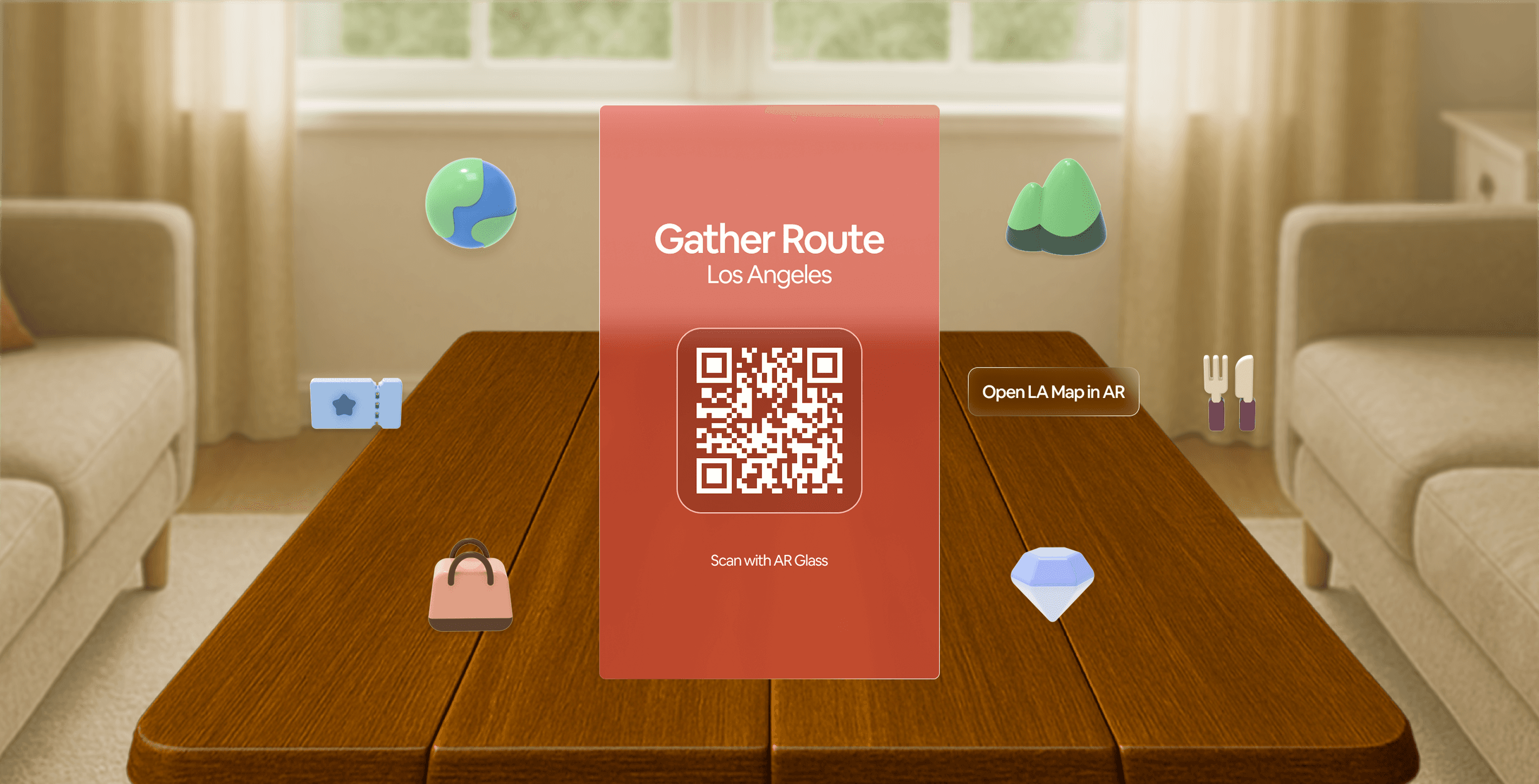
Gather Route: Calm Spatial Computing
Designing a collaborative AR travel interface that bridges digital data and human connection.

[Role]

UX/UI & Interaction Designer (Team)

[Duration]

14 Weeks, 2025

[Tech Stack]

Augmented Reality, Figma, Spatial UI

AR/VR Design

Calm Technology

Spatial UI

The Challenge & Logic

Designing for Shared Reality

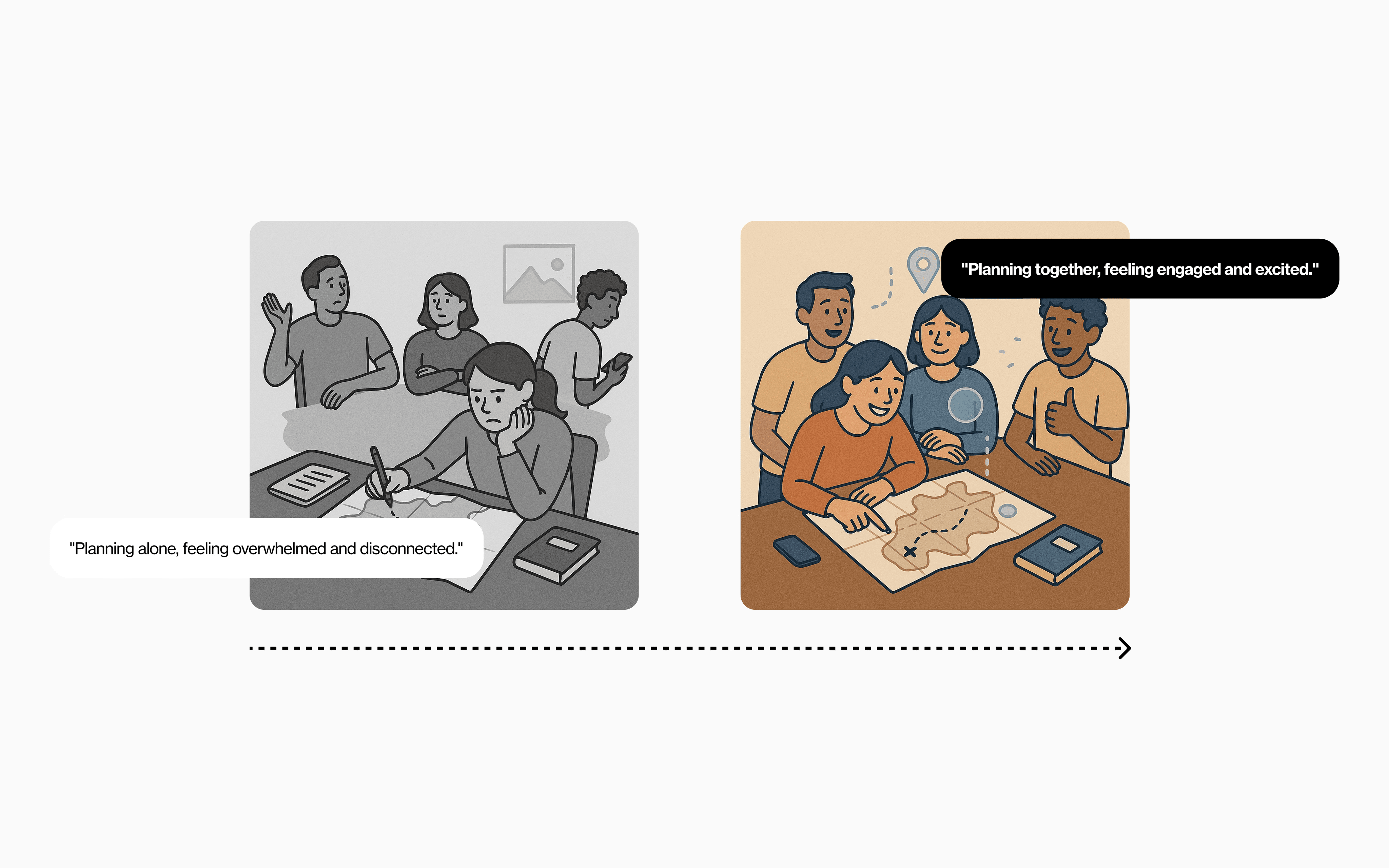
Travel planning typically isolates groups into individual phone screens, effectively killing the shared excitement of the journey before it even begins. My primary challenge was breaking this digital isolation and bringing users back to a shared physical table.

To achieve this, I investigated how Augmented Reality could bridge the gap between abstract digital data and genuine human connection. The goal was to create a 'Shared Reality' where technology actively facilitates human eye contact rather than obstructing it.

Rather than overwhelming users with fully immersive VR, this spatial system is deeply rooted in the philosophy of 'Calm Technology.' The foundational logic relies entirely on utilizing a physical paper map as the definitive digital spatial anchor.

I designed a precise spatial hierarchy where high-level geographical data sits closest to the physical map, while interactive personal bookmarks hover seamlessly in the mid-ground. This contextual layering ensures the tangible table remains the undeniable ground truth for collaborative decision-making.
Execution & Craft

An Inclusive Gestural Grammar

To maintain spatial lightness, the UI employs a refined Glassmorphism visual language. Semi-transparent containers allow the physical texture of the paper map to bleed through, ensuring the digital interface feels like a natural extension of the room’s ambient lighting.

Furthermore, I developed a precise system of shared spatial pins, beautifully color-coded by user. This transforms invisible digital browsing into a visible, communal act, allowing every participant to instantly see what others are exploring in real-time, aligning group visibility flawlessly.

Recognizing that group travel involves family members of various tech-literacy levels, I prioritized Natural Mapping. Gestures intuitively mimic real-world physical actions, such as physically 'dropping' a pin or naturally 'scanning' a map, eliminating the harsh abstraction of traditional dropdown menus.

The interaction flow ensures digital objects strictly respect physical boundaries. The camera detects the high-contrast map, instantly locking the coordinate system. Contextual data like Airbnb prices hovers over specific geographies, seamlessly translating shared choices into a clear, actionable, collaborative itinerary.

Execution & Craft

An Inclusive Gestural Grammar

To maintain spatial lightness, the UI employs a refined Glassmorphism visual language. Semi-transparent containers allow the physical texture of the paper map to bleed through, ensuring the digital interface feels like a natural extension of the room’s ambient lighting.

Furthermore, I developed a precise system of shared spatial pins, beautifully color-coded by user. This transforms invisible digital browsing into a visible, communal act, allowing every participant to instantly see what others are exploring in real-time, aligning group visibility flawlessly.

Recognizing that group travel involves family members of various tech-literacy levels, I prioritized Natural Mapping. Gestures intuitively mimic real-world physical actions, such as physically 'dropping' a pin or naturally 'scanning' a map, eliminating the harsh abstraction of traditional dropdown menus.

The interaction flow ensures digital objects strictly respect physical boundaries. The camera detects the high-contrast map, instantly locking the coordinate system. Contextual data like Airbnb prices hovers over specific geographies, seamlessly translating shared choices into a clear, actionable, collaborative itinerary.

Impact & Takeaway

Quiet AR for Human Connection

Gather Route successfully breaks the rigid assumption that Augmented Reality must be inherently immersive and overwhelming. Here, AR remains beautifully quiet. It supports the organic conversation happening in the real world rather than aggressively replacing it with an isolating screen.

By allowing spatial technology to seamlessly dissolve into the background, the interface ensures that genuine human group dynamics take center stage. It proves that spatial computing can be an intuitive, inclusive tool thoughtfully designed to foster connection across diverse generations.

Quiet AR for Human Connection

Impact & Takeaway

Gather Route successfully breaks the rigid assumption that Augmented Reality must be inherently immersive and overwhelming. Here, AR remains beautifully quiet. It supports the organic conversation happening in the real world rather than aggressively replacing it with an isolating screen.

By allowing spatial technology to seamlessly dissolve into the background, the interface ensures that genuine human group dynamics take center stage. It proves that spatial computing can be an intuitive, inclusive tool thoughtfully designed to foster connection across diverse generations.

All Works